Parametric CAD, 3D printing
Mini Air
A filter box, written as code and printable at home.
The question it started from
Could I design a physical object the way I design software — write the part as a program, check it the way you check a build, and hand someone the files?
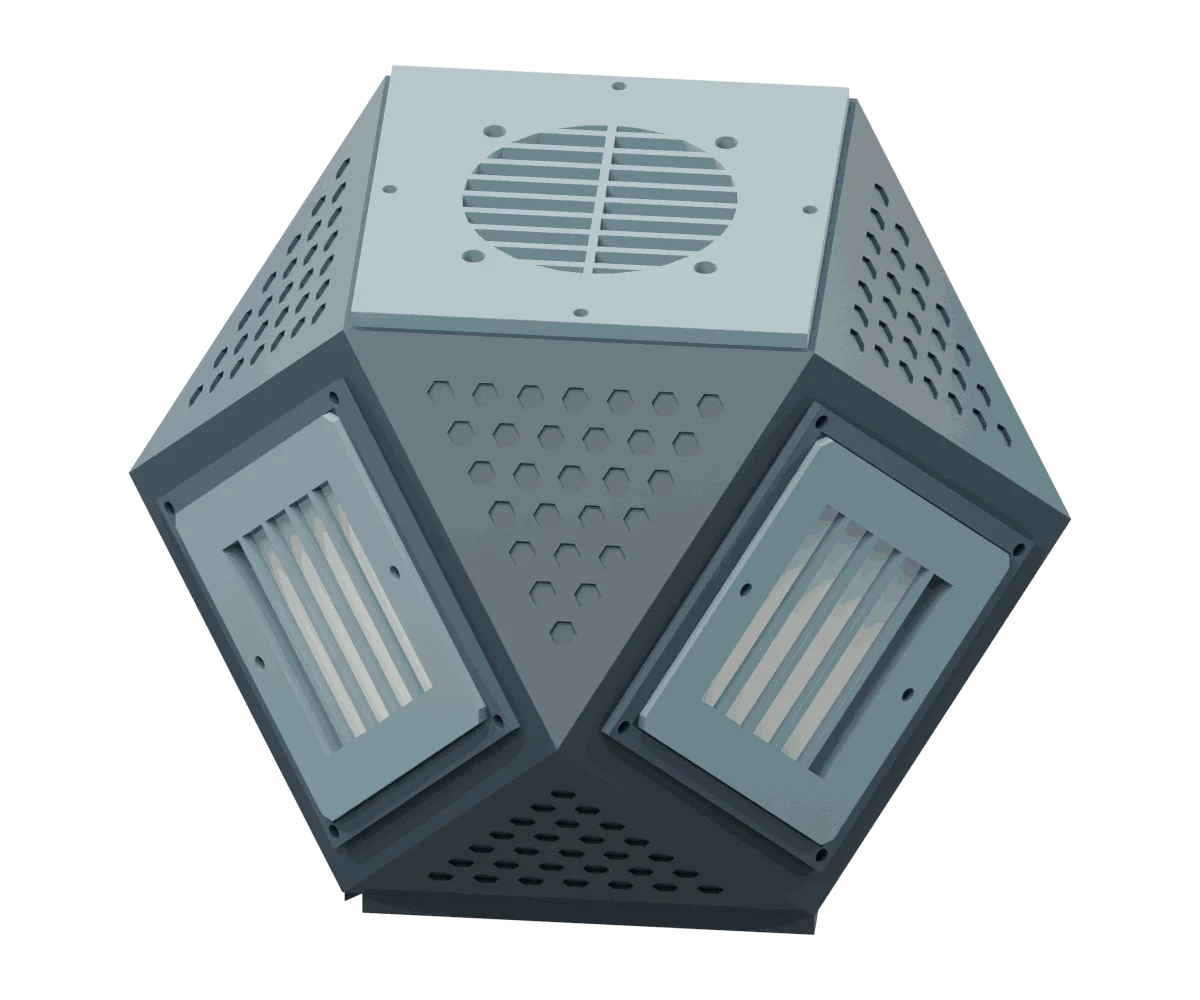
The box as it is modelled: a cube standing on a corner, a filter cassette on each side face and the fan grille on top. 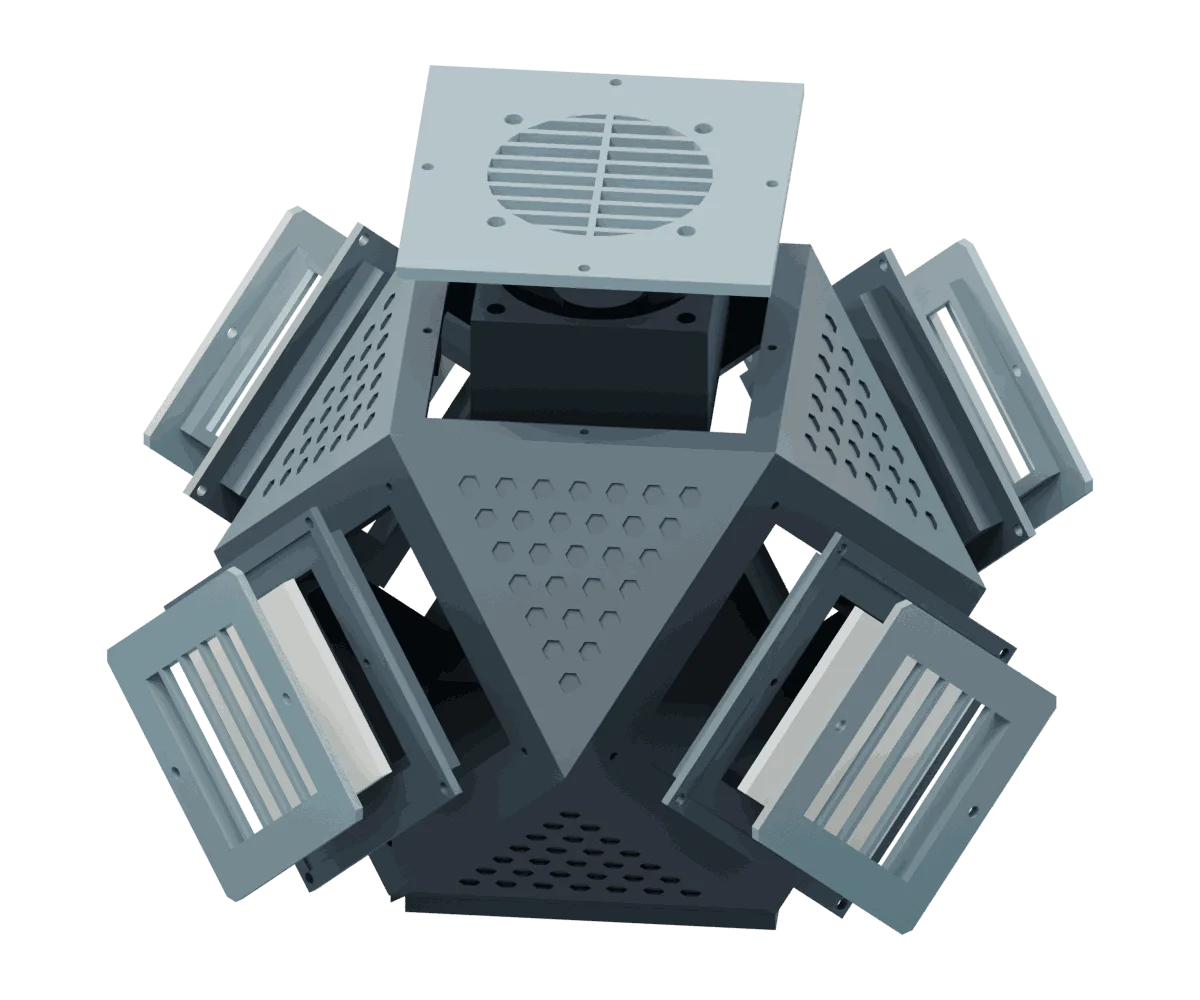
The same object pulled apart — the fan cap lifted off the shell, and the four cassettes with their grilles swung clear of the faces they sit in.
The problem
A printable object is only useful if somebody else can actually make it. The shape is the easy half; the hard half is the clearances, the fasteners, the order you put it together in, and the fifty small decisions a photograph of a finished print never shows.
Most published models hand you an STL and wish you luck.
The idea
Write the box as a program. If the whole thing is generated by a script, a clearance stops being a shape I pushed around until it looked right and becomes a number in one place.
Then publish the half nobody publishes: what you buy rather than print, how it goes together, and how it is wired — as a page you can turn in 3D instead of a PDF.
What I contributed
I designed the box: four printed parts, the path the air takes through them, the clearance chosen for each fit, and the decision to drive it with a single 5 V fan.
I wrote the model as a parametric Python script, and the verification pass over it, so the geometry is checked before anything reaches a printer.
And I built the page that teaches the build — the parts in 3D, an eight-step assembly animation, and a seven-step wiring walkthrough for the connected version.
- 01
In
Through the four side faces and nowhere else: the hexagons in the shell are closed recesses, so no air bypasses the filters.
- 02
Filter
Each face holds a foam behind a printed grille. Coarse dust — this is not HEPA.
- 03
Fan
One 5 V fan on the top face pulls through all four cassettes at once.
- 04
Out
Through the grille in the fan cap, the only outlet.
- 05
Measured
Not yet. The geometry is verified; the performance is not — nothing has been printed.
What exists today
- A cube 97.6 mm on a side, standing on a corner: four side faces carry filter cassettes, the top face carries the fan and the outlet grille.
- Four files to print — one shell, four cassettes, four filter grilles, one fan cap — in PETG, 0.4 mm nozzle, 0.20 mm layers.
- A parametric model in Python that regenerates all four, and the check that runs over it: 15 objects, 105 pairs, every mesh watertight and consistently wound, and no two parts intersecting by more than a thousandth of a cubic millimetre.
- Clearances decided per fit rather than once for everything — 0.3 mm a side for the cassettes, 0.2 mm for the grilles, 0.4 mm for the fan cap — with 0.19 mm of foam compression designed in.
- The kit to download: the four STL files, a printing guide, the component list, and a 3D model of the finished assembly.
- A page that walks the build: the parts in 3D, what you buy instead of printing (28 Ø2 × 6 screws, 12 M3 pieces, 6 gaskets to cut, 4 filter foams, one 5 V fan), and an eight-step assembly you can pause and rotate.
- A design on paper for a connected version — an SPS30 particle sensor and a XIAO ESP32C3 taking the place of one filter cassette — specified down to the pull-up resistors, with its own seven-step wiring guide.
What is left to build
- It has not been printed. The geometry report says so in its own first line: geometry only, no printing and no airflow measured. Fit, sealing and airflow are claims I have not earned yet.
- It is not a HEPA filter, and the page says so where a visitor would otherwise assume it. The foams catch coarse dust; their effect on fine particles is not demonstrated.
- The connected version is a design and nothing more — never built, never tested, and the software that would read the sensor, drive the fan and talk over Bluetooth is not written.
What it taught me
Being exact about what an inspiration actually buys you is harder than borrowing the shape. The hexagons on the shell are a honeycomb reference and, in this version, nothing else — closed recesses, not a network of shared walls, so they save no material and add no stiffness. Termites are in the project's name and are not the functional reference either: the air is moved by a USB fan. Writing both of those on the page cost nothing, and it is the only reason the rest of it can be believed.
Once the part is a program, the work stops being modelling and starts being deciding. A clearance becomes a parameter, and the real question — which number is right — is the one that was there all along.
A verification pass is the hardware version of a test suite. Checking every pair of parts for interference is worth it because the failure then shows up in a second, instead of four hours into a print.
Next
Cageframe & Prometheus